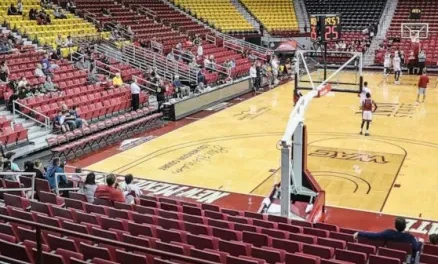
After a hard-fought 83-79 victory over the 10th-ranked Duke Blue Devils last month, Wake Forest celebrated with their fans on the floor as soon as the final buzzer sounded. Initially, it may have appeared to be a harmless case of court-storming once the home team secured a massive win over a highly regarded conference opponent. However, roughly five seconds later, it was clear that a member of the opposing team had suffered an injury.
As Duke center Kyle Filipowski raced off the floor to preserve his health, he collided with a Wake Forest fan and subsequently injured his right knee. Just last month, Iowa women’s basketball phenom Caitlin Clark was knocked to the floor by an Ohio State fan after the 2nd-ranked Buckeyes defeated the 6th-ranked Hawkeyes 100-92 in overtime. So, what should be done about court-storming in college basketball nowadays? Well, that is the question that I will tackle in this piece.
While making a guest appearance on the popular morning sports talk show, “Get Up”, Jay Bilas wasn’t afraid to voice his opinion on the current court-storming dilemma in the college game. When asked to speak on the subject, the ESPN college basketball analyst stated “Fans don’t belong on the court. And fans may not want to hear that, but it is true. One time, all you have to do is once they’re on the court, don’t let them off. Just say, you’re all detained and give them all citations or arrest them if you want to and then court stormings will stop the next day.”
Essentially, Bilas is adamant about seeing court-stormers receive the appropriate punishment for making the idiotic decision to leave their seats and sprint onto the floor. Players definitely feed off the energy they receive from their fans on a nightly basis, but from Bilas’ viewpoint, that doesn’t justify the fans joining in on the post-game fun on the hardwood, considering they didn’t participate in the game action at any point in time.
Seth Greenberg, who also serves as a college basketball analyst for ESPN, isn’t against court-storming in any way, shape, or form. Still, he does believe that there is one key safety measure that needs to be implemented moving forward. While discussing all the hot college basketball topics in the studio, Greenberg mentioned, “First and foremost, you wanna court storm? That’s great; the game ends, give me one minute. I call it the one-minute grace period. One minute to give the visiting team a chance to get off the court. Once that one-minute passes, the buzzer goes off; here come students. They run to the middle of the floor, take pictures, hug, and jump up and down. Life is good.”
So, unlike Bilas, Greenberg strongly believes in finding a low-risk way to bring home fans and players together after a monumental victory. Yes, it would require eager college students to practice patience for a minute or so, but Greenberg suggests that it would prevent unnecessary injuries during such a joyous occasion for the winning squad.
While I understand Jay Bilas’ perspective on this topic, I’m going to have to side with Seth Greenberg in this ongoing debate. Look, court-storming is a valuable college basketball tradition that shouldn’t perish anytime soon, but changes need to be made in order to accommodate all parties involved. After a crushing road loss, the visiting team’s objective will be to exit the floor as quickly as possible. If you prioritize their well-being before turning your attention to the fans preparing to create an everlasting memory, then you’ll be able to successfully fulfill that team’s need for protection. After that, well, you can start focusing on the individuals who are interested in taking part in the celebratory festivities that typically take place near half-court.
If you refuse to utilize a step-by-step process once the contest has concluded, then you’ll be playing a dangerous game that could result in a season-altering injury to a player who failed to escape the chaos unscathed. To put it simply, it shouldn’t be difficult to organize a well-thought-out plan in advance and execute it when it’s showtime. Sure, college basketball wouldn’t be the same without court-storming, but I think that everyone would agree that it’s more satisfying to witness when it isn’t being performed in a reckless fashion.